
Claude Code plugin
Turn a repository into a live, documented, search-indexed site.
repo-revamp is the playbook that takes a GitHub repository from "here is an old repo" to a verified public site, without changing the product.
What it does
Most repositories are judged in the first minute: by the README, by the demo, by whether a search engine can find them at all. A revamp fixes that surface. It is also the kind of work that quietly breaks things, because the person doing it is editing the same repository the product lives in.
repo-revamp turns the work into a playbook with a state machine. A read-only recon establishes the facts. A numbered spec asks the owner the decisions that matter, one recommendation per question. One delegated agent builds a generated site in docs/ behind a deterministic builder and a set of hard gates. The orchestrator verifies every claim itself, deploys on the owner's go, and records what it learned.
The product is frozen throughout. A presentation-only revamp may change the README, the site, the builder, the requirements file, the site workflow and an append-only .gitignore. A boundary diff proves it: if the diff prints a product path, the pull request is out of scope.
The phase state machine
Every revamp moves through eight phases in order. A phase's exit gate must be green before the next one starts, and the state file records where the work stopped, so a fresh session resumes instead of starting over.
Scroll the diagram sideways to see all of it.
Text alternative: INTAKE closes when RECON.md exists; SPEC when the owner's USER DECISIONS are recorded; BUILD when the local gate is green and a draft pull request is open; REVIEW when the V1 to V16 checks are green; DEPLOY when the live URLs answer; SEO when the sitemap is submitted; SHIP when the merge happens on the owner's explicit go; CLOSE when the tracker and the handoff are updated.
The state file is _revamp/<repo>/STATE.md. It holds the phase, the branch, the head, the gates, the open questions and the next action. The revamp-status command prints it in five lines, which is what a resumed session reads first.
What the plugin ships
The repository is small on purpose. The depth lives in the reference files, which are read one phase at a time rather than all at once. The skill is the contract; the references carry the detail; the commands start each part of the work; the agents do the delegated work; the scripts verify and inventory.
Scroll the diagram sideways to see all of it.
Text alternative: At the centre is the repo-revamp plugin. Around it: one skill file, 17 reference files numbered 00 to 16, 7 templates for state, spec, briefs, the pull request body, the verify recipe and the managed CLAUDE.md block, 5 slash commands, 3 agents for building, recon and verification, 3 scripts for verification, screenshot inventory and plugin validation, the danube-labs marketplace entry, and the external host, GitHub Pages.
- InstallThe one-line install, the marketplace route, the requirements and what a working install looks like.
- Quick startThe first revamp in numbered steps, with the commands and the state file each phase writes.
- PhasesThe eight phases, their exit gates and the state file that survives a crash.
- GatesThe deterministic builder, the gate list, the secret scan and the CI job that runs the same command.
- ScreenshotsInventory, de-duplication, perceptual clustering, review, redaction on a copy, derivatives and a manifest.
- DeploymentGitHub Pages and Cloudflare Pages, the two DNS postures and the certificate nudge.
- OrchestrationOne implementer, a written brief, progress and handoff files, and lessons that become rules.
- ReferenceEvery command, agent, reference, template and script, generated from the real files.
A real run
The capture below is the output of claude plugin details repo-revamp on a machine where the plugin is installed. It is not a mock: the component inventory and the token estimates come from the installed plugin. The inventory lists six skills: repo-revamp itself and the five commands.
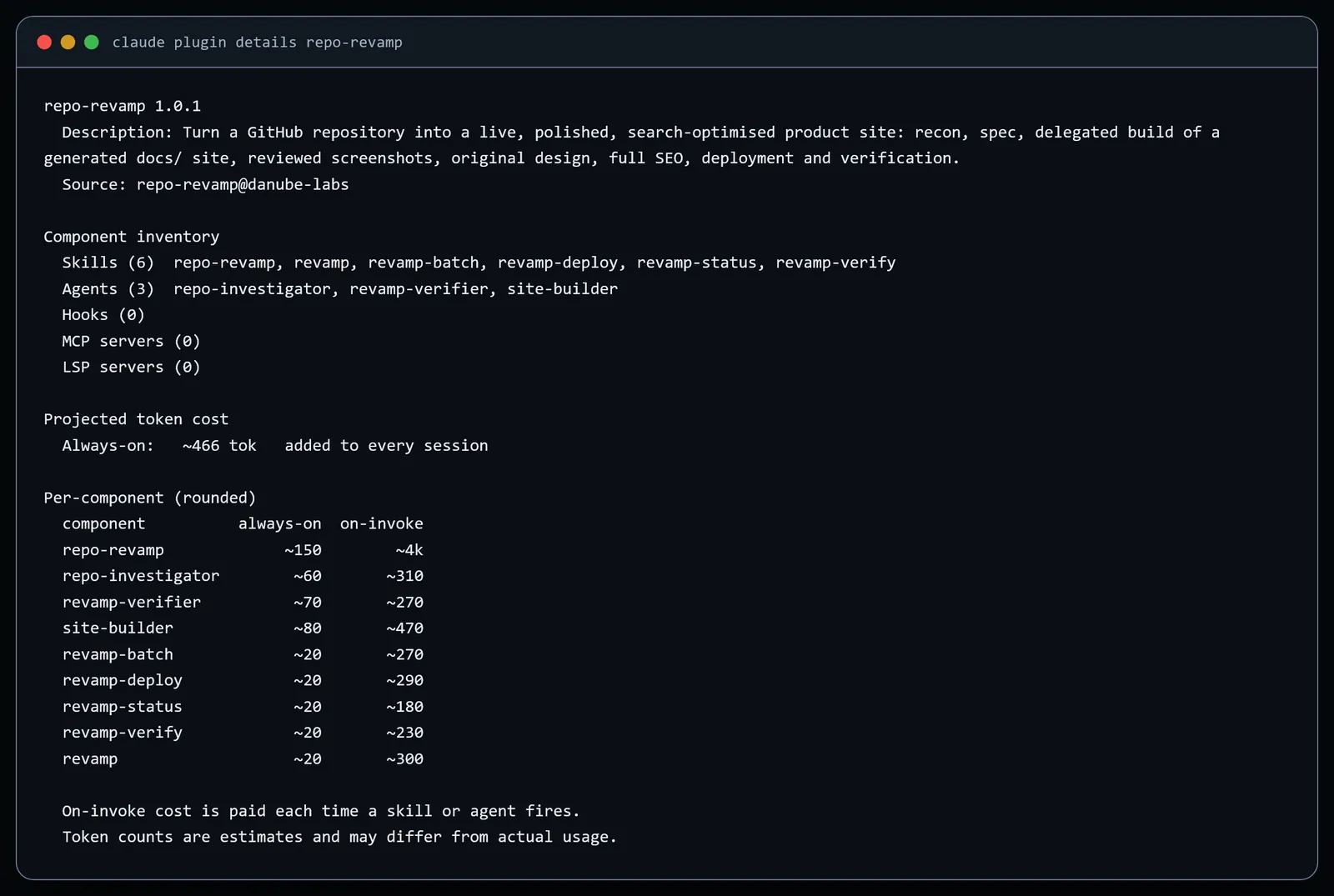
The projected token cost is the plugin's always-on cost, not the cost of a revamp. A revamp session reads a few reference files and runs commands; the always-on figure is what every session pays for having the plugin installed.
Verified quick facts
Every number below is computed from the repository by the site builder, not typed by hand. The claims ledger behind this page records the evidence for each one.
- Version
- 1.0.1
- Licence
- MIT
- Reference files
- 17
- Templates
- 7
- Commands
- 5
- Agents
- 3
- Scripts
- 3
- Markdown lines
- 3489
- Python lines
- 637
- Requires
- Claude Code, git, gh, Python 3.12
Install
One command installs the plugin from the marketplace in this repository:
/plugin install repo-revamp --marketplace FiredMosquito831/repo-revampOr add the marketplace first and install from it by name. Both routes are in the install guide, together with the requirements and what a working install looks like. Nothing is installed globally, and no configuration file is edited by hand.
Questions people ask first
Does it change my product code?
No. A presentation-only revamp may change the README, the site, the builder, the requirements file, the site workflow and an append-only .gitignore. The boundary diff must print nothing else, and a product change is a stop-and-report event.
What does it need?
Claude Code with plugin support, git, an authenticated gh for the GitHub steps, and Python 3.12 for the scripts. The screenshot clustering needs Pillow and imagehash in a scratch environment, never in the repository.
What happens when a fact cannot be verified?
It is cut. Every factual statement on a generated page needs a row in the claims ledger with evidence that resolves to a file in the repository. A number that appears in no source is a bug, not a rounding decision.
The FAQ answers more, including how long a revamp takes, what it costs to run and what it cannot do.
Where to go next
- PhasesWhat each phase does and what closes it.
- GatesWhy the build is deterministic and what stops it.
- ScreenshotsHow an image earns its place on a page.
- DeploymentThe two hosts and the DNS record that must not be flipped.
- OrchestrationHow the work is delegated and tracked.
- AboutWho builds it, what state it is in and the honest limits.